




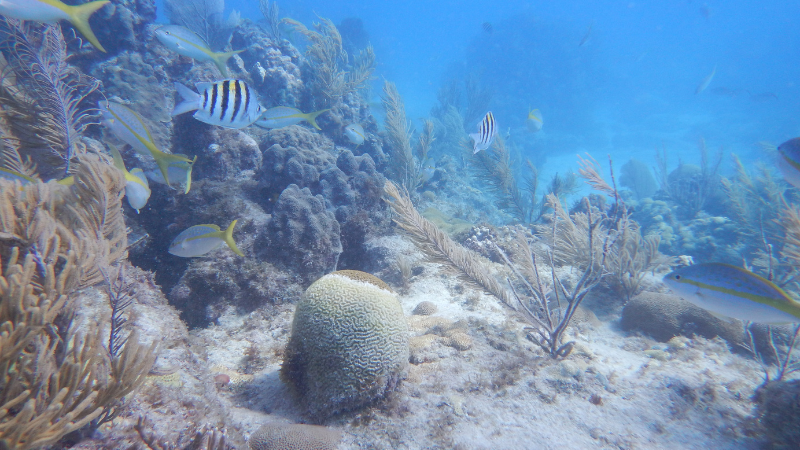
Healthy coral reefs support some of Florida’s most iconic fish species, but managing these fisheries for the future requires understanding far more than where fish are found today. Scientists also need to know how populations are connected, how they adapt to changing environments, and how climate change may affect them in the years ahead.
Thanks to funding from our Foundation’s Koons-Ayala Marine Fisheries Science & Conservation Endowment, researchers at the University of Central Florida are using cutting-edge genomic technology to answer these questions. This $25,000 grant supports a multidisciplinary study that combines genetics, habitat modeling, and larval dispersal research to improve the conservation and management of Florida’s coral reef fish populations.
The project focuses on three complementary areas of research. First, scientists are developing habitat suitability models to predict how reef fish distributions may change under future climate scenarios. Next, they are analyzing DNA collected from reef fish across Florida, including the Florida Keys, to identify genetically distinct populations and better understand how local environments have shaped their evolution. Finally, researchers will combine these findings with models of larval dispersal to better understand how fish populations remain connected across Florida’s coral reef ecosystem.
Together, these approaches will provide fisheries managers with valuable information about which populations are most vulnerable, which habitats are most important to protect, and how reef fish may respond to changing environmental conditions. By understanding these biological connections, conservation decisions can be based on stronger scientific evidence and better support healthy fish populations for future generations.
The project is already making progress. Researchers have begun collecting fish samples along Florida’s coastline, with additional sampling underway in the Florida Keys. DNA extraction and genetic analyses are beginning, while habitat data are being prepared for future modeling efforts. As the research advances, the combined data will help reveal how reef fish populations respond to environmental stressors and provide new tools for ecosystem-based fisheries management.
Scientific discoveries like these help ensure Florida’s marine resources remain healthy, resilient, and productive. By supporting innovative research today, our Foundation is helping provide the knowledge needed to conserve Florida’s coral reef fisheries for generations to come.
To see how our Foundation is investing in conservation across Florida, subscribe to our newsletter and follow along as we share more Grants at Work stories.