
The SS United States is one step closer to beginning its second life beneath Florida’s waters.
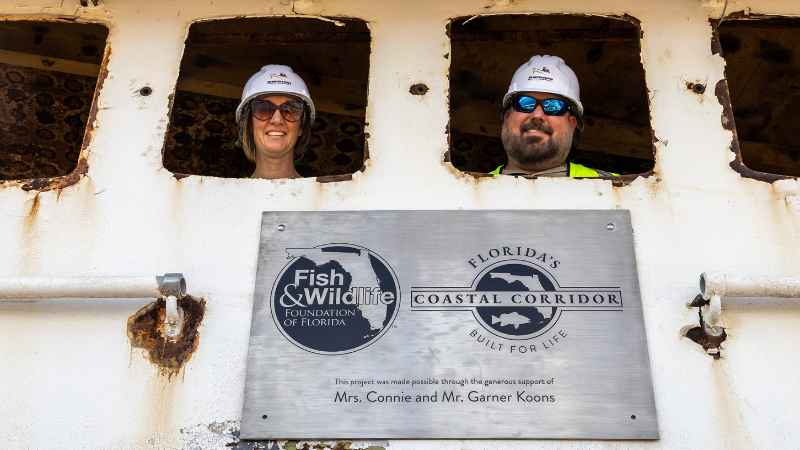
Earlier this year, we shared the story of the historic ocean liner and the ambitious effort underway to transform it into what is planned to become the world’s largest artificial reef. Now, as crews continue preparing the ship for deployment off the coast of Okaloosa County, there is a new sign of progress aboard the vessel: a Fish & Wildlife Foundation of Florida and Florida’s Coastal Corridor plaque has officially been affixed to the ship.
The plaque recognizes the generous support of Garner and Connie Koons, whose $2 million donation to our Foundation is helping make this extraordinary project possible.
From American Icon to Marine Habitat
Built in the early 1950s, the SS United States was once a symbol of American engineering and innovation. The ship still holds the record for the fastest transatlantic crossing by an ocean liner.
Its next voyage will look very different.
The SS United States is being prepared for deployment as an artificial reef off Florida’s Panhandle, where its massive structure will create new hard-bottom marine habitat. Once underwater, surfaces of the ship can provide places for marine organisms to attach and grow, while its structure can offer shelter, feeding areas, and habitat for fish and other marine life. Artificial reefs can also create new destinations for fishing and diving, helping spread recreational activity across a greater number of sites.
It is a fitting next chapter for a ship whose history has always been tied to the sea. Once carried by the ocean, the SS United States will soon become part of the habitat beneath it.
A New Landmark for Florida’s Coastal Corridor
The project also represents an exciting milestone for Florida’s Coastal Corridor, a statewide initiative led by our Foundation and the Florida Fish and Wildlife Conservation Commission.
Florida’s coastal habitats do not exist in isolation. Mangroves, seagrass beds, oyster reefs, shorelines, natural reefs and artificial reefs form an interconnected system that supports marine life, fisheries, coastal communities and Florida’s outdoor economy.
Florida’s Coastal Corridor brings partners together to strategically create, enhance, and connect these habitats, including the construction of artificial reefs that expand marine habitat and recreational opportunities. When the SS United States reaches the seafloor, it will become one very large piece of that bigger vision.
Learn more about Florida’s Coastal Corridor.
Frequently Asked Questions About Preparing Ships for Artificial Reefs
Is a ship just cleaned out and sunk?
No. Preparing a vessel for use as an artificial reef is a significant remediation process. The U.S. Environmental Protection Agency has established national best management practices specifically for preparing vessels intended to become artificial reefs. The goal is to address materials that could pose environmental concerns before the vessel enters the water.
What happens to fuel and oil aboard the ship?
Fuels and oils are among the materials specifically addressed during vessel preparation. EPA guidance identifies petroleum products as materials of environmental concern and establishes cleanup goals and methods for dealing with them before deployment.
What about lead paint or other old coatings?
Paint is also specifically addressed in federal vessel-to-reef guidance. Older ships can contain coatings and residues that require evaluation as part of the remediation process. The goal isn’t simply to make a ship look clean. Crews work toward established environmental cleanup standards designed for vessels entering the marine environment.
Are other hazardous materials removed?
Potential materials of concern can include asbestos, PCBs, mercury, refrigerants, fuels, oils, paint residues, debris, and other materials. EPA guidance identifies where these materials may occur aboard older vessels and provides cleanup performance goals for preparing vessels for artificial reef use.
How do we know sinking a ship won’t harm the environment?
Artificial reefing isn’t simply a matter of choosing an old ship and sending it to the bottom. Vessel preparation and strategic site selection are central to the process. EPA says appropriate cleanup and remediation, combined with proper reef-site selection, help maximize the opportunity for converted vessels to provide environmental benefits as artificial reefs.
What happens after the ship reaches the bottom?
The vessel’s steel structure provides hard substrate and complex habitat underwater. Over time, marine organisms can colonize its surfaces, while the ship’s structure provides habitat for fish and invertebrates. It can also become a destination for divers and anglers, creating recreational and economic benefits alongside its habitat value.
The SS United States once crossed the Atlantic faster than any ocean liner before it. Its final journey will be much shorter, but its impact could last much longer.
The plaque is in place. The ship is being prepared. And its next chapter is getting closer.