

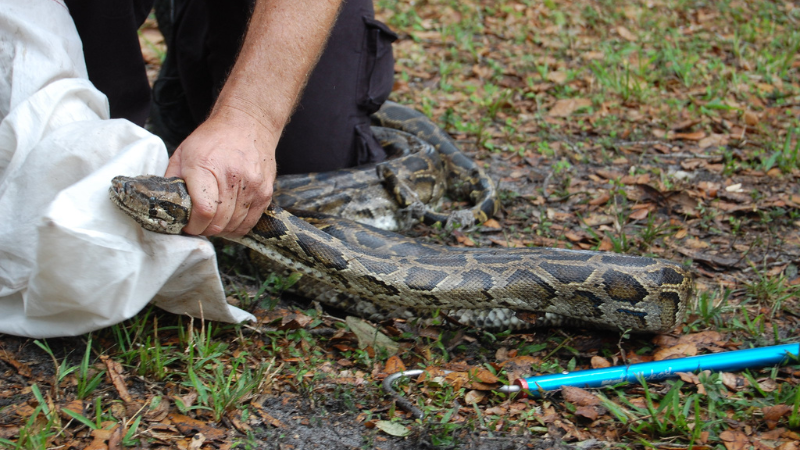
Burmese pythons are among the greatest threats to wildlife in south Florida. These invasive constrictors prey on native mammals, birds, and reptiles, disrupting food webs and competing with native predators. They also pose a serious challenge for wildlife managers because they are remarkably difficult to find in the vast wetlands they inhabit.
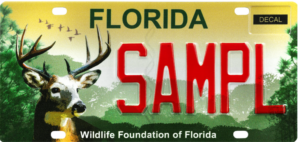
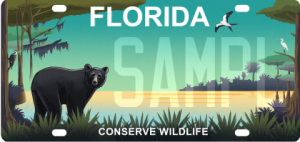
Thanks to funding from our Foundation’s Conserve Wildlife specialty license plate, the Florida Fish and Wildlife Conservation Commission and the Conservancy of Southwest Florida are using an innovative strategy to locate and remove breeding pythons in Picayune Strand State Forest. Rather than searching blindly across thousands of acres, researchers rely on specially selected “scout snakes” to lead them directly to other pythons.
The process begins by surgically implanting radio transmitters into adult male Burmese pythons. During breeding season, these males naturally seek out females. By tracking the tagged snakes using aerial telemetry and ground crews, researchers can locate breeding aggregations that would otherwise remain hidden in dense vegetation. Once found, the adult pythons are humanely removed from the landscape.
This targeted approach focuses on the most important animals to remove: large, reproductively active adults. During the two breeding seasons supported by this grant, researchers tracked 18 scout snakes. Their efforts resulted in the removal of 75 adult Burmese pythons, including 44 reproductive females and 31 males, weighing a combined 5,135 pounds.
The project helps reduce pressure on native wildlife while protecting one of Florida’s most important conservation landscapes. Picayune Strand State Forest provides essential habitat for the endangered Florida panther, and reducing python populations helps restore prey species that panthers and many other native animals depend upon.
The project has become even more effective as restoration work continues within the Picayune Strand Restoration Project. Canal filling and spoil pile removal have restored more natural wetland conditions while also reducing the cover that pythons once used for shelter and nesting. These habitat improvements have increased scout snake detection rates and made it easier for researchers to locate breeding pythons. Wetland-dependent wildlife, including numerous wading bird species, has already begun returning to restored areas where they had not been observed before restoration.
This work builds upon more than a decade of successful collaboration. Since 2013, the Conservancy of Southwest Florida’s scout snake program has removed more than 1,700 adult Burmese pythons weighing over 53,000 pounds while contributing to more than 25 peer-reviewed scientific publications that continue to improve invasive species management across Florida.
Every invasive python removed is one less predator threatening Florida’s native wildlife. Thanks to support from the Conserve Wildlife specialty license plate, innovative projects like this are helping protect some of Florida’s most vulnerable ecosystems and the species that call them home.
You can support invasive species management and wildlife conservation across Florida by purchasing a Conserve Wildlife specialty license plate.
Buy your plate now