




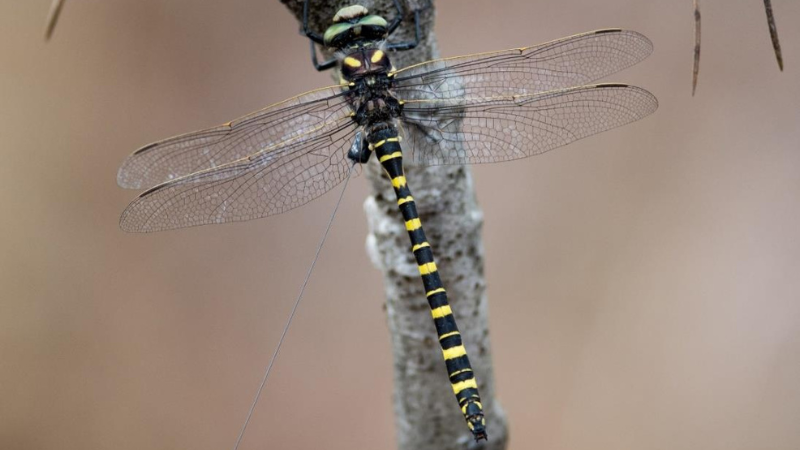
Dragonflies are among Florida’s most recognizable insects, but some species are so rare that scientists are still uncovering basic information about how they survive. One of those species is Say’s spiketail dragonfly, an uncommon insect found only in portions of northern Florida and southeastern Georgia. Closely tied to seepage streams within longleaf pine sandhill habitats, this species faces an uncertain future as its specialized habitat continues to decline.
Thanks to funding from our Foundation’s Conserve Wildlife specialty license plate, researchers with the Florida Fish and Wildlife Conservation Commission are using cutting-edge radio telemetry technology to better understand how Say’s spiketail dragonflies move across the landscape and what habitats they need to thrive.
Studying dragonflies presents a unique challenge. Adult Say’s spiketails are active for only about six weeks each spring, and their movements can be difficult to track. To solve this problem, researchers are carefully capturing adult dragonflies and fitting them with tiny radio transmitters weighing just 0.15 grams. Once released, the insects can be tracked multiple times each day, providing valuable information about where they travel, feed, perch, and reproduce.
Early results have already revealed surprising insights. During the project’s pilot study, researchers tracked individual dragonflies for up to 16 days and found that some traveled nearly a kilometer from where they emerged. The study also showed that Say’s spiketails use much larger areas than previously understood, with some individuals occupying more than 50 hectares of habitat. That’s roughly 94 football fields, including the end zones!
The information collected through this project will provide land managers with practical recommendations for habitat management, prescribed fire planning, and the protection of critical breeding areas. It will also help scientists better understand how rare dragonflies use Florida’s disappearing longleaf pine landscapes.
While Say’s spiketail may not be as well-known as a panther or manatee, they are an important part of Florida’s biodiversity. By supporting research on imperiled species like this one, we can make more informed conservation decisions and ensure these unique insects remain part of Florida’s natural heritage for generations to come.
The Conserve Wildlife specialty license plate helps fund conservation projects benefiting a wide variety of species, from black bears and indigo snakes to endangered Florida grasshopper sparrows and lesser-known species like Say’s spiketail dragonfly. You can support work like this by buying yours today.